CycleKyoto HP LInk

Monday, August 1, 2011

Nishijin Honryuji Temple

Nishijin Temple本流時

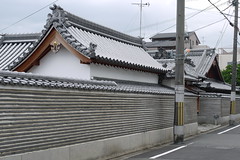
On a hot slow ride through Nishijin en route to Kitayama on Saturday, we rode past Honryuji Temple. It was founded in 1488, and has a distinctive onion-like dome and tiled outer wall.

Just up the street is a small preserved area with guest houses and museums. Among the latter is the Orinasukan Handmade Fabrics Museum.

It was created as a teaching center and is housed in a fabulous old building.

You can learn about dyeing, weaving culture, and industrial arts, all of which took and take place in Nishijin, the weaving center of Japan.

Along this section are normal residences. A quick peek down one found several bikes at arest.
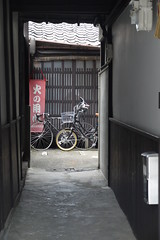
Nishijin Alley© CycleKyoto.com

CycleKyoto Home Page

Tags


Sunday, July 31, 2011

Shrine Gates Near Shisendo Temple

Near Shisendo詩仙堂の近くの鳥居

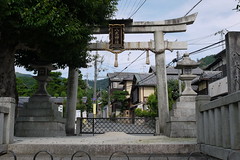
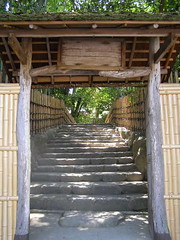
On the slope up to Shisendo Temple from Kita Shirakawa Dori street, there is a large torii gate more or less in the middle of the road.

The road bends around the torii and large tree within its grounds.

Farther up, on the right, is Shisendo Temple. The area is dotted with temples and shrines, and makes for a good ride.

A good place to start would be Shugakuin Imperial Villa, for which permission is required to enter. Without it, you will not get in. A trip to the offices of the Imperial Household Agency, in Gosho, are required.

From there. it is a short rural ride to Manshuin, a Tendai sect temple founded in the 8th century. Continuing on, you come to Enkoji, other smaller temples, and then Shisendo itself.

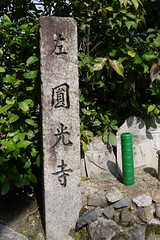
Below left is an old road marker that reads "left for Enkoji Temple."

It is on the narrow street below the entrance to Shisendo Temple.

© CycleKyoto.com

Enkoji SignCycleKyoto Home Page

Tags


Saturday, July 30, 2011

Kyoto Online Bicycle Manners Campaign

kyoto-bicycle-manners京都 自転車利用マナー向上戦隊 ほっとかナイス

The great minds at Kyoto City Hall are at it again, this time with a vengeance - and a web site.

In an effort to get the burgeoning cycling population to behave, a new web site has gone live.

A direct transliteration of the site name is "hottoka nice."

The women who appear on the site are suspiciously similar in appearance to the trendy and not very musical girl band AKB48.

Without getting too esoteric, the seven women - "Hottoka Nice" idols - are a manners squad.

In Kansai dialect, "hotte oite" means to leave or discard something. Thus, "hottakanai" would mean "don't throw/leave it." "Hotto ka nice" is a belabored play on words, adding the English "nice" at the end.

And that is what the platoon of mecha kawai (very cute) girls are fighting: bicycles left around the city (and bad jokes).

The site also has information on the basic rules of cycling, where to get off and push a bike, crime prevention, if you are towed, and more.

Good luck to them. Although, cynics that we are, real behavior modification would probably take place if the cops handed out a few tickets - actual fines - now and then.

Still, you never know.

© CycleKyoto.com

CycleKyoto Home Page

Tags


Friday, July 29, 2011

Bicycling Kodaiji Temple

kodaiji temple自転車で高台寺へ

Kodaiji Temple is one of Kyoto's gems.

It was established in 1606 by Nene, the wife of Toyotomi Hideyoshi. The temple was built in memory of Hideyoshi.

Kodaiji sits atop a bluff above the Path of Nene, a lovely street named for the aforementioned Nene, and overlooking central Kyoto.

The whole area is rich in history and perhaps the best preserved section of Kyoto.

A wonderful day would be to ride from central Kyoto, park your bike, and then head first up to Kiyomizu Temple. From there, wander down Ninenzaka and Sannenzaka towards Nene no Michi.

From there it is easy to stroll Ishibei no Koji, the postcard pretty alley that connects to the Path of Nene.

Due south is Gion, due east is Yasaka Shrine and Chionin Temple.

Details

Kodaiji Temple
9:00 to 17:30 (entry until 17:00)
Admission: 600 yen (Kodaiji and Sho Museum)
900 yen (Kodaiji, Sho Museum and Entokuin; 1000 yen from mid December to late March)


© CycleKyoto.com

CycleKyoto Home Page

Tags


Thursday, July 28, 2011

Makino Shozo Kyoto Film Legend

makino-shozoマキノ省三墓地

Makino Shozo is a legend in the history of Japanese film.

Born in 1878, he was a director, producer, and one of the major pioneers of Japanese cinema.

Makino was born in Kyoto and his mother ran a theater, which he often visited and absorbed from an early age.

He is remembered today for directing the 1928 epic "Jitsuroku Chushingura" (True Record of the Forty-seven Ronin).

Makino founded several film companies before dying in 1929.

His legacy is also thanks to his prodigy.

Two of his sons, Sadatsugu Matsuda (1906–2003) and Masahiro Makino (1908–1993), were well known film directors. Yet another son, Mitsuo Makino, was a film producer. Still another, Shinzo Makino, worked as a director.

He is buried at Tojiin Temple, just south of Ritsumeikan University.

© CycleKyoto.com

CycleKyoto Home Page

Tags


Wednesday, July 27, 2011

Kyoto Graffiti Shisendo

kyoto graffiti京都落書き詩仙堂

On the narrow hilly streets close to Shisendo Temple are many of the traditional walls that delineate property lines and protect against intruders.

The walls are also divinely beautiful.

The main purpose of the ride was to visit, again, Shisendo.

It was built in 1641 by the poet Ishikawa Jozan (1583-1672), originally as a retreat for hermits.

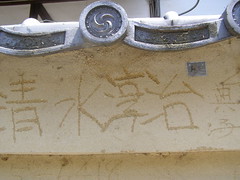
Another visitor, one Kiyomizu Junji, pulled out his pen knife and signed his name on a nearby wall.

Access

Shisendo
27 Monguchi-machi, Ichijoji, Sakyo-ku,
Kyoto
Tel: 075 781 2954
Admission: 500 yen for adults

For those taking public transportation, get off at Ichijoji Station on the Eiden Railways. Walk east toward the hills in the distance (Mt. Hiei). Cross Shirakawa Dori (street) and continue straight. Walk up the slope. On your right you will come to the gate of Shisendo. Another option is to take the number #5 bus from Kyoto Station and get off at the Ichijoji-sagarimatsu-cho bus stop.

For those cycling, it is about 10 minutes from the Silver Pavilion and the Philosopher's Walk.


Shisendo Temple, Kyoto© CycleKyoto.com

CycleKyoto Home Page

Tags


Tuesday, July 26, 2011

Cycling Shibuya?

shibuya, tokyo, street東京渋谷で自転車を乗る?

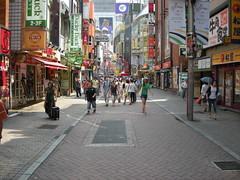
From a Kyoto perspective what is striking about this photo of Shibuya - Tokyo's uber fashion mecca - is not the buildings. Plenty of those in Kyoto.

It is not the crowds. Kyoto's 1.5 million people can jostle with the best of them, and population density in the ancient capital is heavy because of narrow streets.

And it is not the tacky signs and general delicious messiness of the streetscape. Kyoto has both in spades.

It is, rather, the absence of bicycles.

The picture was, full disclosure, taken almost three years ago on a Sunday morning stroll not far from Shibuya Station.

Things may have changed.

However, there is not even a bike parked in front of one of the shops.

Is there any comparable area of Kyoto without one single bike?

© CycleKyoto.com

CycleKyoto Home Page

Tags